“The waste land of the homestead,
The arid sandy spot,
Where reaper’s song is never heard,
Where wealth is never sought,
But where the sunshine lingers,
And merry breezes come
To gather pungent perfumes
From the mullein-stalks abloom.”
Jean Blewett (1862-1934) (3)
Common Names
Anishinaabe: Nookaadiziiganzh (3)
Lakota: apé hiŋšmá (1)
Navajo: Nátʼostsoh (3)
English: Common Mullein, Great Mullein, Velvet Plant, Hare’s Beard (8); Adam’s Flannel, American Mullein, Blanket Leaf, Candleflower, Clown’s Lungwort, European Mullein, Feltwort, Fluffweed, Hag’s Taper, Hedge Taper, High Taper, Jacob’s Staff, Lady’s Foxglove, Old Man’s Flannel, Our Lady’s Flannel, Cowboy Toilet Paper, Shepherd’s Staff, Tabac du Diable, Torch Weed, White Man’s Footsteps, Wilde Ice Leaf, Woolly Mullein (3); Aaron’s Rod (4)
German: Kleinblütige königskerze, Königskerze, Wollkraut (which respectively literally translates to “small flowered king’s candle, king’s candle, and wool herb) (6)
Irish: Coinnle Muire (7)
Norwegian: Filtkongslys, lungegras, lungerot, sanktolvasljos (respectively, felt king’s light, lung grass, lung root, St. Olav’s light) (6)
Botanical Description
Family: Scrophulariaceae (Figwort)
Life cycle: Biennial
Origin: Non-native, invasive weed (in N. America) from Europe (8,) Africa, and Asia (3)
Height: 2 to 6 feet
Blooms: June to September
Habitat: Waste areas; dry and disturbed soils; seen in large groups on roadsides, empty lots, railroads, gravel pits, and degraded fields (8); recently cleared areas, uncultivated fields, and abandoned places (3); sunny banks, lanes, and waysides (6)
As seen above, Mullein is known by many names; one source states there are over 50 English names for the herb! (8) This number is outdone by the number of species in the Verbascum genus, which is over 450. Some are ornamental, while some are also used medicinally (ie V. densiflorum, phlomoides, and thapiforme,) but V. thaspus is the most commonly used mullein in herbal medicine. This herb is native to Eurasia and Africa, but has since been naturalized throughout the Americas and Australia. Some species in this genus are deemed invasive in certain temperate regions. While it will grow in partial shade, mullein prefers sunny areas, and dry & disturbed soils with a sandy, chalky composition (3.)
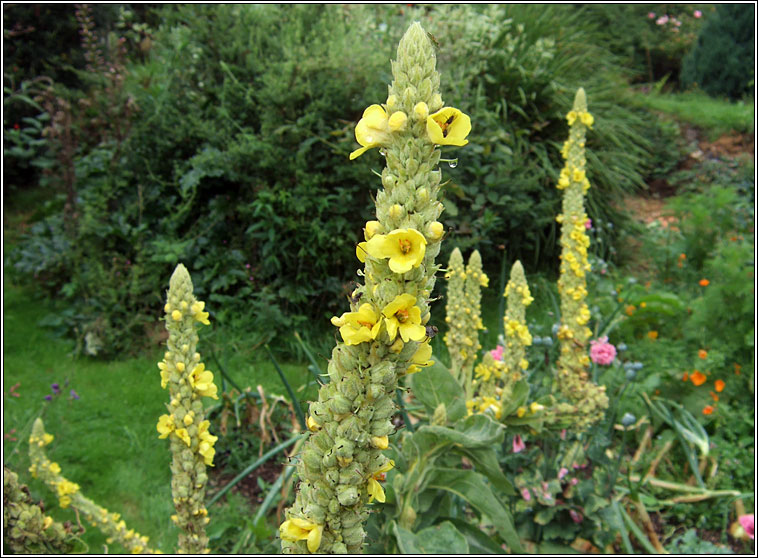
Nicholas Culpeper describes the growth pattern of mullein as “white woolly leaves on a stalk rising four or five feet high, with yellow flowers in a long spike” (6.) In more detailed terms, mullein has large, oval-shaped leaves (sometimes growing as long as 15 inches and as wide as 5 inches,) widely spreading at the base of the plant, and grow in a rosette pattern around stalk. The leaves get smaller and more erect as you follow them up the stem. They are thick and “soft like felt or flannel,” and also are covered densely in short hairs. Mullein has a singular stem, with no branches, and is also very hairy (8.) When it comes to the stalk of mullein, we can find a strong example of the Doctrine of Signatures; the strong and sturdy structure of this plant part resembles the spine, which relates to some of the musculoskeletal applications of this herb (3.)
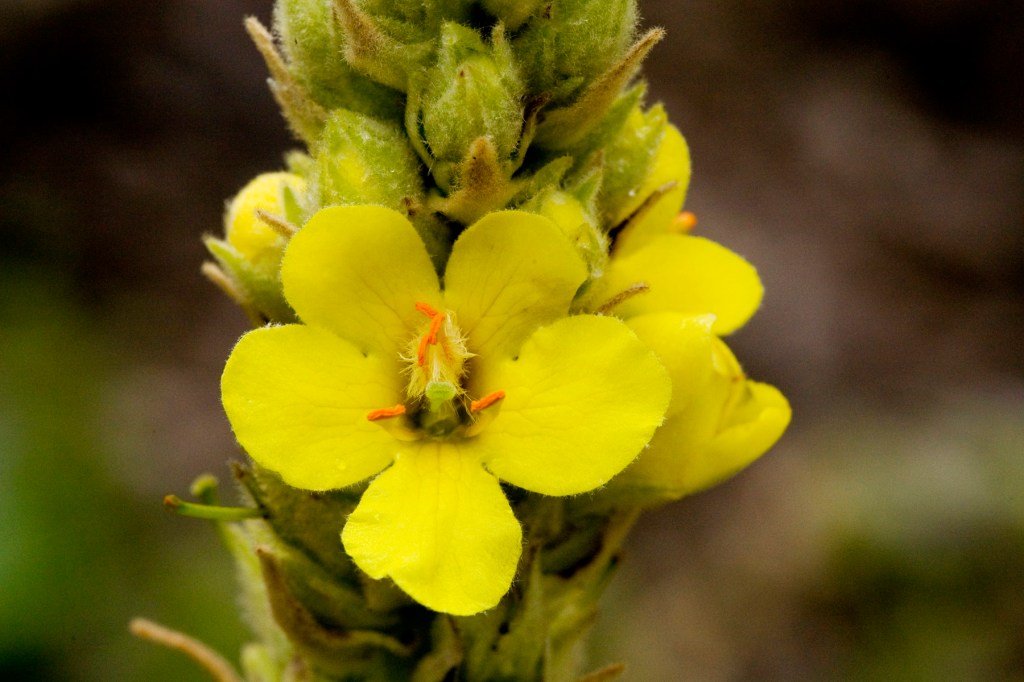
The club-shaped spike that grows at the top of the plant is where the flowers can be found; each flower has 5 petals (upper 3 petals are slightly smaller than the bottom 2) and only a few flowers are open at a given time. There are 5 orange tipped stamens in the middle, along with a single, curved, green style. The fruits of this plants are oval-shaped 2-celled capsules that contain many seeds. The cells split down the seam in order to release the seeds. These seed heads persist through winter.
First year mullein plants can be identified by the fact that the entire plant is only a rosette of basal leaves, usually 1 to 2 feet across; the flowering stem bolts in its second year. This plant can be found in nearly every Minnesotan county, in non-wetland areas (8.)
Monograph
Parts Used: Flowers, leaves, and root; seeds not used due to toxicity (3)
Harvesting: Can be harvested at any time in the growth cycle, even when it begins to get cold (mullein can handle temperature of 5 degrees Fahrenheit.) For flower collection, it is best to harvest in the morning, right after opening, on a dry day (good to do on the day you see the bloom occurring, as the flowers tend to fall off the next day.) Roots are harvested at the end of the second growing season. This is a plant that is very self-sufficient when it comes to seeding, so there isn’t much concern about killing off the plant when uprooting.
Because mullein is a bioaccumulator, there are some things to take stock of when harvesting mullein; it can be good practice to collect 50 feet away from roads, or avoid foraging altogether if found by severely polluted areas (railroads, roof drip lines, industrial sites,) or anywhere harsh chemicals may have been sprayed (3.)
Energetics: Generally moistening and cooling (5,) but may vary by plant part;
- Flowers: Cooling to neutral, moistening
- Leaves: Cooling, slightly moistening
- Roots: Slightly warming to neutral, slightly drying
Taste: Astringent, mildly bitter, salty (in a mineral sense,) slightly sweet
Actions: Analgesic, antiseptic, astringent, demulcent, diuretic, emollient, expectorant, inflammation-modulating, lung tonic, spasmolytic, vulnerary
Tissue States: Dry/atrophy, wind/tension (3)
Specific Indications:
- Flower: earache
- Leaf: chronic lung issues
- Root: Low back pain and inflammation (5)
System Affinity: Varies by plant part
- Flower: Nervous, Respiratory
- Leaf: Digestive, Lymphatic, Respiratory (lungs)
- Root: Musculoskeletal, Urinary
Active Constituents: Aucubin, essential oils, fats, fixed oils, flavonoids, harpagide, harpagoside, hesperidin, iridoid and lignin glycosides, minerals, mucilage, polysaccharides, proteins, saponins, tannins, verbascoside, vitamins (3)
Safety: Generally safe, with no known herb/drug interactions (3, 5.) It is best to strain preparations of the leaf very well (with paper or cloth strainers) for the sake of removing the leaf hairs; these hairs can irritate mucosa when ingested. Be considerate of topical exposure and/or inhalation of “plant dust,” as it could cause contact dermatitis or irritation in some people (3.) The seeds contain rotenone, which is poisonous! (5)
Dosage:
- Standard infusion: 4 to 8 ounces, 2 to 4x/day (prepare this way for lung complaints)
- Tincture: fresh root (1:2, in 95% alcohol); dried root (1:5, in 65% alcohol) — 10 drops to 3ml (0.6tsp), 3x/day for back issues
- Glycerite: dried leaf (1:8); 2.5-10ml (0.5-2tsp) 3x/day for lung issue
- Oil: fresh flowers (1:4, in olive oil); used as ear drops (5)
Indigenous Uses
While this is not a native plant, it’s no surprise that (since the herb proliferates the landscape of Turtle Island) various Indigenous groups have found ways to work with the plant in the recent centuries since its arrival and naturalization caused by colonizers. In her document “Culturally Important Plants of the Lakota,” Linda Black Elk says that the infusion of the leaf is good for reducing the formation of of mucus, and also for expectorating mucus, and goes on to say it is used for any chest congestion tied to bronchitis or influenza. She also writes about it being a topical remedy for diabetic ulcers of the legs or feet, via a leaf decoction being applied as a poultice (1.)
Mullein is used by various tribes for its analgesic effects, such as Cherokee including mullein in a compound recipe that is taken for general pains. Rheumatism and musculoskeletal pains seems to be a specific indication across various groups. The Astugewi use a leaf decoction internally for this, while the Catawba, Delaware, Rappahannock use a leaf poultice on problem areas. The Iroquois peoples have a very particular orthopedic use of mullein; it (along with other herbs) are applied as a poultice on babies who have a broken coccyx. It is not only a musculoskeletal herb for humans in some traditions; the Rappahannock people also have employed it (as a poultice) for animal sprains!
What appears to be the most shared application of mullein across different Indigenous groups of Turtle Island is for respiratory issues, specifically as a cough and cold remedy. On the Native American Ethnobotany Database, there are 15 different groups mentioned that have respiratory-related uses for this plant! For the case of colds and coughs, there are various preparations; leaf decoctions (done by the Atsugewi, Creek, Delaware, and Thompson peoples) or leaf infusions with sugar (done by the Mohegan and Shinnecock peoples,) as well as brown sugar and honey (done by the Cherokee.) The Mohegan people take the hot water extract with molasses for coughs. The Delaware people have a unique cough syrup recipe, where they combine mullein leaf with coltsfoot, plum root, and glycerin. Interestingly enough, the Navajo will smoke mullein for cough issues.
This, of course, does not cover the full extent of the different methods and uses of mullein in tribes across the country, but here are some other unique uses I found in my research: It has psychological uses in the Navajo and Hopi herbal traditions (in that order, used in the event of one clearing their mind “if lost,” and for if one is not “in their right mind.”) The Hopi also smoke mullein, in a blend of other herbs, as a cure for “person with the power to charm.” This plant has also found its way into ceremonial spaces of the Thompson peoples, where it is used in the sweat lodges; another ceremonial use comes from the Isleta tribe, who smoke the leaves as a “ceremonial tobacco.” For hunting, the Navajo rub a cold infusion of the leaves on hunters’ and horses’ bodies for strength. And for one last example, the roots are made into necklaces by the Abenaki for teething babies, to be worn and chewed on as a toothache remedy (2.)
Western Uses
This herb has long been used in European herbal traditions, and can be found in Nicholas Culpeper’s Complete Herbal. In this, he mentions uses ranging across musculoskeletal, digestive, integumentary, and respiratory issues. One stand out entry says, ” The seed bruised and boiled in wine and laid on any member that has been out of joint, and newly set again, takes away all swelling and pain;” fascinating, if not a little concerning, seeing as many modern herbalist do not engage with the seed! He goes onto say that a decoction of mullein root is supportive in the event of chronic coughs, convulsions, and cramps, along with also being a gargle for earaches. Culpeper recommends bathing in a leaf decoction (combined with sage, marjoram, and chamomile flowers) for cramps, colds, or stiff sinews. To remove warts, he instructs one to to apply the leaf/flower juice or powdered, dried roots directly onto the affected area. He also suggests a decoction of the leaf and root for swelling, tumors, and throat inflammation (6.)
In more recent times, mullein has continued its historic use as a respiratory ally. Its primary use in modern, Western herbalism is for complaints of this nature. Frequently, mullein is employed in the cases of chronic lung issues, such as COPD or asthma. The plant contains saponins, which are responsible for loosen the mucus in the respiratory system; mullein also has a soothing and hydrating effect on the lungs, which makes it a supportive herb in times of respiratory inflammation or dryness. Mullein also has a common respiratory use outside of the lungs; the flowers are extracted in olive oil for a soothing ear drop preparation (5.)
I have used this herb in my own practice for a few years now. My initial introduction was through dried herb hot water infusions, generally for respiratory issues. Early on in my practice, I formulated a blend that was used as both a lung tonic tea and herbal smoking blend for a friend who was trying to curb their cigarette intake; the person reported their respiratory system feeling cleaner, and also found the smoke blend to be supportive in curbing their nicotine intake. In just the last year, I have been working with a fresh mullein tincture, which I find to be much more palatable, as well as very supportive for the lungs. I especially relied on it during the summer wildfires of 2026 here in Minnesota.
Magic, Mythology, and Folklore
Astroherbalism
Planetary ruler: Saturn ♄
While some texts refer to mullein as “the good staff of Hermes,” (aka Mercury)(3,) sources going back to the 1600s will cite this plant as an herb of Saturn (4.) The connection to Saturn can be seen through the morphology, habitats, and medicinal qualities of the herb. The leaves are seen growing “in a tight ring,” which evokes Saturn’s rings, and the tall flower stalk gives off the appearance of a spine; the spine being comprised of many bones, and Saturn being the ruling planet of all bones. The individual plants grow near each other, and often are never touching; this could evoke and idea of isolation, which is one of many Saturnian associations.
Mullein also seems to like boundaries (one of Saturn’s core themes.) This plant thrives in very dry, disturbed soils (even poisonous ones,) has prickly & irritating hairs, endures harsh winter cold, and its seeds can live for decades in soil — even retaining germination ability for up to one hundred years (3.) Astrologically, Saturn is the planet of Time, and is considered harsh and barren, which are all illustrated concepts/phenomena in the previous sentence.
Folklore
In the parts of the world that mullein is native to, it has been very well-known. One common use of the plant across various cultures was as a candlewick; this is reflected in mullein’s different names, across various languages. Ancient Romans dipped whole stalks in tallow, wax, or suet for this purpose, and sometimes were specifically used at funerals. They called mullein “candela regia” and “candelaria,” which some believe is the origin of the term “roman candles,” as the seeds pop and spark when combusted. The Ancient Greeks were also known to do this, and called it “flego” or “fluma,” meaning ‘to set on fire.’ It also shows up in Jewish history, known as “butzin” in Hebrew, (meaning ‘candle’ in Aramaic.) Mullein has been used in the Jewish tradition, however it was deemed unfit use as a shabbat/sabbath light, as they felt that it did not burn well — this is probably due to the fact that it doesn’t burn as smoothly or consistently as others do, and gives off more smoke than some other plants would.
In Europe, some Christians have associated it with their religious figure Mary, calling it “Our Lady’s Candle.” In England specifically, white mullein is also known as “torches,” with white mullein (V. lychnitis) is known as “candle-week-flower.” Scottish anthropologist Sir James George Frazer wrote about mullein regarding its protective properties, as well as the plant’s connection to the season of Midsummer (which happens to be the flowering time of this plant.) On the Eve of St. John, in Poitou, France, mullein sprigs were passed around by children and shepherdesses and put into a bonfire to protect livestock from witchcraft and illness; they would later take home the ashes for protection, either scattering in fields to ward of corn cockles, or keep them in the home to safeguard against thunder. In some parts of Europe, there were used as a fumigant to banish demons, and similarly they were used in Asia for fending off bad spirits! In less fantastical uses, Pennsylvanian Germans used the seeds to expel lice in pigs, and the roots and flowers were used for keeping rats & mice away in Denmark (3.)
In the mullein monograph from Rowan & Sage, the main folk information comes out of Ireland, where the herb is known as Coinnle Muire (7.) The majority of this comes from the book ‘Visions and Beliefs in the West of Ireland’ (1920,) written by Lady Augusta Gregory. One belief is that mullein could be worked into a charm for calling your children back to you. Another anecdote comes in the form of a personal account from one Mrs. Ward; she says that if the wind changes while one begins to cut mullein, one will lose their mind! She also says that if you are not being paid to cut down the plant, “they” will not like it, adding that she heard tale of a woman cutting mullein who heard “an enchanted voice” say, “Don’t cut that if you’re not paid, or you’ll be sorry,” leaving room to wonder if this may be fae who are demanding that the humans seek proper compensation for their work (certainly an amusing thought.) Mrs. Wards finishes with saying, “…if you put a bit of this with every other herb you drink, you’ll live forever. My grandmother used to put a bit with everything she took, and she lived to be over a hundred.”
Lady Gregory’s book also goes into some folklore relating to mullein and butter, the latter being a focus of Irish culture and superstition. She provides a story in which a woman is trying to churn butter, but to no avail. She goes to her neighbor’s home, where she is made furious at the sight of the abundant amount of butter there. This woman was so upset, she nearly began to be hostile to her neighbor, until the person ran to their garden, and came back with mullein leaves. The neighbor said, “Put these leaves in under your churn, and you’ll find your butter come back again.” Miraculously, this allowed the woman to find success in churning her butter (3.) Across all of the different cultural uses and folklore, I find it interesting that this plant holds space in both extremely practical, mundane applications, as well as revered or even holy uses, which speaks to its presence as an extremely common herb, with such an astonishing medicinal impact.
Works Cited
- Black Elk, L. S. (1998). Culturally Important Plants of the Lakota. Sitting Bull College. https://puc.sd.gov/commission/dockets/HydrocarbonPipeline/2014/HP14-001/testimony/betest.pdf
- BRIT – Native American Ethnobotany Database. (n.d.-c). http://naeb.brit.org/uses/search/?string=verbascum
- Corbett, Sarah, Nelson, Sabrina. (2023). Mullein Monograph. Rowan + Sage Herbaria Membership. Retrieved from
- Culpeper, N. (2004b). Culpeper’s complete herbal.
- Easley, T., & Horne, S. (2016b). The modern herbal Dispensatory: A Medicine-Making Guide. North Atlantic Books.
- Hjelmstad, R. (n.d.-a). Filtkongslys: Verbascum thaspsus. Urtekildens Planteleksikon. https://rolv.no/urtemedisin/medisinplanter/verb_tha.htm
- Seawright, J. (n.d.). Irish Wildflowers – Great Mullein, Verbascum thapsus, Coinnle Muire. irishwildflowers.ie. https://www.irishwildflowers.ie/pages/274a.html
- Verbascum thapsus (Common Mullein): Minnesota Wildflowers. (n.d.). https://www.minnesotawildflowers.info/flower/common-mullein