Lamiaceae (Mint family)
Habitat: Native to Asia & Europe, naturalized in North America. Grows in fields & pastures (2)
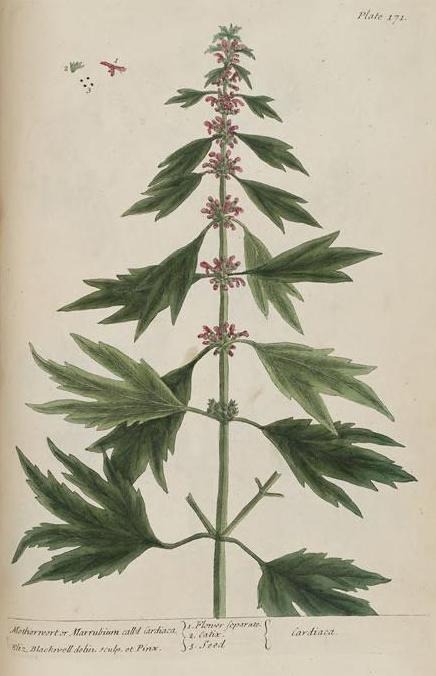
Botanical description: Perennial growing from 2-5 feet tall, mildly downy and “wandlike” in its appearance. Alternate pairs of rough and dark green leaves; lower leaves are broadset and palmate, while upper leaves are pointed and 3-lobed.
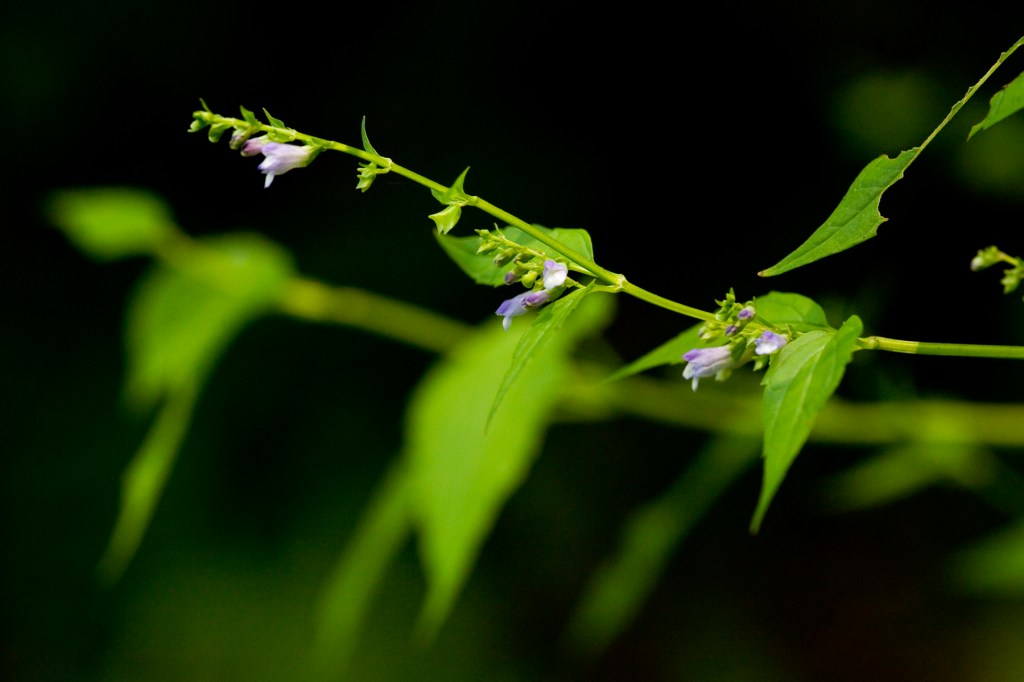
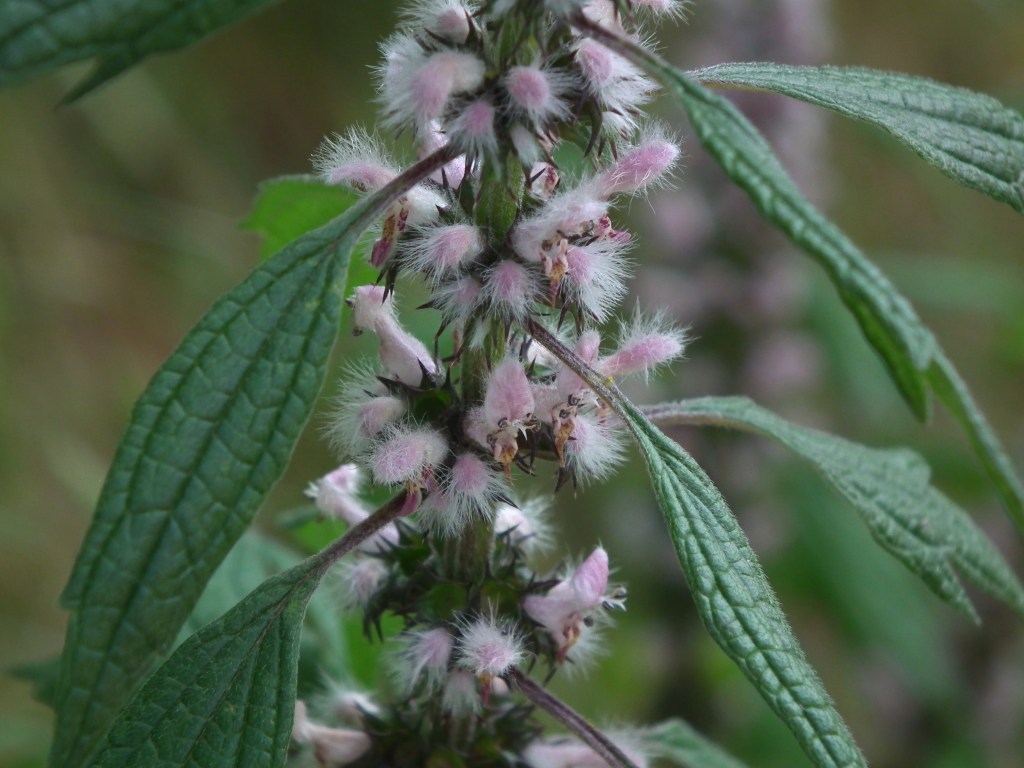
Purple to white-red flowers, with lots of axillary whorls; in Scudder’s words, the upper lip is “clothed with dense, white shaggy, upright hairs,” and the lower lip splits into 3 near equal lobes that are variegated and deep in color (5.)
King describes it in King’s American Dispensatory as having “peculiar, aromatic, not disagreeable odor,” and very bitter, slightly aromatic taste (2.)
Parts used: Eclectics used the whole plant; aerial (1) and roots (2.)
History – Eclectic Use:
The most common uses of Motherwort by the Eclectic Physicians are as an emmenagogue, antispasmodic, and nervine (1.) It is also listed as an expectorant and tonic (4.)
Felter calls it a simple emmenagogue and recommends warm infusion for amenorrhea; also says it is supportive for general discomfort relating to AFAB reproductive organs (1.) King utilized pilulae leonuri compositae (compound pills) for “many uterine affections,” saying that this particular formula was a uterine tonic and alterative. He also said it was useful for suppressed lochia (afterbirth,) specifically calling it “superior to any other remedy. Mixing with “ictodes” (Ictodes foetida) and Black Cohosh resin, according to him, increases Motherwort’s emmenagogue, nervine, and antispasmodic actions. Other uses that are indicated for the AFAB reproductive system are as an external poultice on the bowls for “suppressed and painful menstruation, etc” (4.) Interestingly, Scudder says “line of experiment will be to determine its influence upon the reproductive organs (5.)
As far as the Eclectic use of Motherwort for the nervous system goes, one thing that came up repeatedly in the texts was an indication for “nervous debility.” Felter observed it to have “considerable control over” the nervous system, and recommended its use for irritation and unrest (1.) In King’s American Dispensatory, it says that mixing extractum leonuri (motherwort extract) with skullcap, cramp bark, nerve root, black cohosh, and/or asclepias can make it antispasmodic and nervine actions stronger. He goes further in depth on the nervous applications of Motherwort; he lists “delirium tremens…morbid nervous excitability, all chronic disease attended with restlessness, wakefulness, disturbed sleep, spinal irritation, and neuralgic pains in the stomach and head”
A lesser talked about use was of the seed (administered in water) for bilious colic, and said to “pass through the bowels when quicksilver will not.” King also spoke on Motherwort being used for hydrophobia (rabies) extensively in Europe and Russia, but that it had not been used as much for the same purpose in the US (2.)
Preparation
The Eclectics would prepare motherwort in a few different ways. For extracts, Scudder talked about tincturing the fresh root with diluted alcohol (4,) while King instructed the powder of recently dried be mixed with alcohol and water (he calls it “extractum leonuri”.) King also wrote about compound pills (“pilulae leonuri compositae), which included alcohol extracts of Lepandra and Unicorn root, and cimicifuga resin; all mixed together to form a pill mass. They used the extract for the same conditions that the tea was recommended for (2.)
Dosage
Old Eclectic texts list varying doses; Sayre says “30-60 grains,” which is 2-4 grams but doesn’t specify what (4), while Scudder mentions 3-5 drops of tincture (5.) Felter worked with a dosage of 2-4fl oz of decoction, every 1-3 hours and 3-6 grains of extract, every 2-4 hours (1.)
Modern Use:
The modern herbalists use Motherwort in almost exactly the same ways as the Eclectic physicians; for the nervous system and uterine support. The only difference being is that there is more understanding of the nervous systems (and the heart’s role in it,) plus more of an “energetic” engagement with the herb. The gut, brain, and heart all contain nervous tissue, but the heart is the only one of these 3 that have cardiac muscle tissues; Motherwort supports in relaxing the heart muscles, acting as an interface between the heart and the nerves. It is because of this that Motherwort is used today to calm down overexcited nerves, as well as palpitations or fluttering, unsteady heartbeat. Motherwort helps engage the parasympathetic nervous system state, which is why current herbalists like to employ it in sleep formulas (specifically in the case of repeatedly waking up through the night (3.)
The modern use for uterine issues look nearly the same; herbalists now revere it as a uterine relaxant that is supportive in the case of stagnant periods (especially when there is emotional agitation and anxiety,) as well as helpful in expelling afterbirth. The afterbirth use’s action comes more so from its relaxant properties, as it only slightly stimulates uterine contraction (the contracting is the effect of Motherwort’s slight oxytocic activity.) However, some herbalists may avoid this herb for people who experience heavy flow (3.)
Sources
1. Felter, Harvey Wickes. The Eclectic Materia Medica, Pharmacology and Therapeutics. 1922.
2. King, et al. King’s American Dispensatory: G-Z. 1900.
3. Midura, Ryn. “Motherwort: Herb of the Week; CommonWealth Holistic Herbalism.” CommonWealth Holistic Herbalism, 10 May 2019, commonwealthherbs.com/motherwort-herb-of-the-week.
4. Sayre, L. E. A Manual of Organic Materia Medica and Pharmacognosy: An Introduction to the Study of Vegetable and Animal Drugs with Syllabus of Inorganic Remedial Agents. 1917.
5. Scudder, John Milton. Specific Medication and Specific Medicines. 1873.