Life cycle: Perennial
Origin: Native
Habitat: Sun, moist fields, along shores
Blooms: July to October
Height: 2 to 4 feet
Found in nearly every Minnesota county, mainly occurring in wetland areas.
Botanical Description
Boneset is an upright growing plant, with erect and densely haired stems, that begin to branch out on the upper section of the plant. The leaves are opposing, and join around the stem which makes it look like the stem is growing through one large leaf. This feature makes it easy to distinguish from other species in the same genus. On occasion, there are plants with leaves that are whorled in 3s! Leaves are up to 2 inches wide and 4 to 8 inches long, and wrinkly with small rounded teeth on the edges. Both sides are hairy, and the underside of the leaves are gland-dotted.
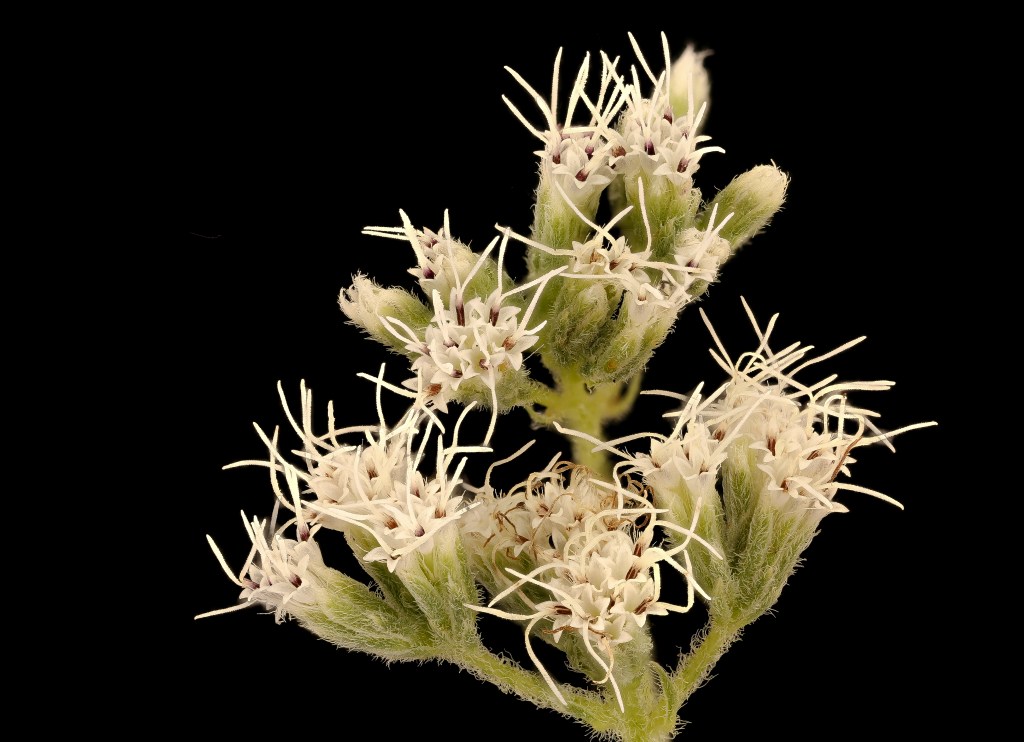
The flowers of boneset are stalked with flat-topped branching clusters at the top of the stem, and grow from the upper leaf axils. They are dull white in color, and star-shaped. Fruits are a dry black seed with a small tuft of hair, which aids in it being carried off into the wind (5.) This plant enjoys the wetlands of so-called “North America,” where it is native to; it prefers rich soil and damp conditions, and likes to have full to partial sun (3.)
Herbal Monograph
Common Names
English: Common boneset, boneset (5,) agueweed, crosswort, feverwort, sweating plant, wild isaac (3,)
Anishinaabemowin (Ojibwe): šiabuksing, šašabwaksing, piškagamisag, niya ´wibûkûk (6,) niya’wibwakak (plural)
Kanien’keha (Mohawk): teyonerahtawe’éhston (1)
Harvesting: best to collect before the plant flowers.
Energetics: cooling and drying (3;) slightly relaxing
Taste: aromatic (4,) bitter, pungent (3,) and acrid
Tissue State: depression, constriction (8;)
System Affinity: Digestive, immune, and respiratory systems
Actions: Antispasmodic, aperient, astringent, bitter, carminative, cholagogue, diaphoretic, emetic, expectorant, febrifuge, immunostimulant, laxative, peripheral vasodilator, stimulant, tonic (3;)
Specific Indications: Large, full pulse that is currently showing small waves. Skin that is hot and full, with a tendency to moisture. Deep seated aching in bones with generally body aches. Hoarse coughs and chest soreness. Urine presenting turbid and high (4.) Also:
- Bronchial catarrh settled in the lungs with atonic mucosa, and lack of cough reflex (specifically in elderly people and/or debilitated cases)
- Indigestion in elderly people
- Jaundice
- Acid reflux
- Influenza
- Beginning of illness
- After malaria
- Crushing pain in the bones
- Muscle aches
- Broken or crushed bones, along with damaged connective tissue
- Osteoporosis and osteomalachia (in this case, boneset recalcifies bone)
- Multiple Sclerosis (in this case, boneset helps rebuild myelin sheaths)
- If one cannot tell if they are getting sick or not
- Measles, mumps, scarlet fever, typhoid fever
- Rocky Mountain spotted fever (8)
Active Constituents:
caffeic acid derivatives (chlorogenic acid, neochlorogenic acid,) diterpenes, fatty acids and fatty alcohols, flavonoids (kaempferol, astragalin, nicotiflorin, quercetin, hyperoside, rutin,) gallic acid, glucoside, polysaccharides (fructans in hot water extract, xylans in alkaline extract,) pyrrolizidine alkaloids, sesquiterpene lactones (guaianolides [uperfolide, eufoliatin, and dihydroeuperfolide in roots, eufoliatorin] and germacranolides [uperfolitin, euperfolin, heliangolid,]) triterpenes and sterols, and volatile oils (β-gurjunene, β-caryophyllene oxide, limonene, linalool, borneol, bornyl acetate, [iso]-eugenol, α-copaene, β-elemene, ar-curcumene, β-caryophyllene, humulene, and δ-cadinene) (3,7)
Astroherbal Correspondence: Saturn ♄
Indigenous Use
As this plant is native to the so-called United States, or also known as Turtle Island, there are various recorded uses of this herb in various Indigenous group’s herbal traditions; the groups mentioned in the Native American Ethnobotany Database are primarily in the Great Plains, Upper Midwest, Northeast, and Southeast “United States.”
Similarly to modern, western uses of the herb, many tribes use a water infusion of for its febrifuge action (including the Ojibwe, Delaware, Iroquois, Menominee, Mohegan, Nanticoke, Seminole and Shinnecock peoples.) It is also used almost unanimously as a cold remedy and an emetic. There are a few tribes (the Mi’kmaq and Penobscot peoples) who even list boneset as a venereal aid in the case of gonorrhea! The Mohegan people like to include it (along with other plants) in a spring tonic, and would go as far to say boneset is a panacea.
The Indigenous groups with the most uses recorded are the Iroquois and Ojibwe. The Ojibwe people will use it for colds, sore throats, “ague,” or as a general disease remedy. They also will use the root to correct irregular menstruation. For rheumatism, it is used externally via a poultice of boiled plant tops, which are to be applied to the problem area (2.) Fibers of boneset root are also combined with the root fibers of common milkweed, and then applied to whistles to attract deer for hunting (6;) this application is referred to as hunting medicine.
Iroquois people have a wide variety of applications for this herb. One application being very representative of how the plant may have earned its English name; they apply a cold leaf poultice on broken bones. Some of them can be found already mentioned above (cold remedy, analgesic, immune issues,) but there are also those that are more specific to just this group. Some of which are as a veterinary aid (whole plant infusions given to feverish horses,) as a medicine against sorcery done to a person, and as a poison; specifically, putting boneset in an enemy’s liquor flask “to kill him!” They also view it as a psychological aid, by using a decoction of the smashed root to curb drinking problems. Outside of physical or mental medicine uses, the Iroquois have also employed this herb in ceremonial settings, for the purpose of divination (2.)
Modern Western Use
The Modern Herbal Dispensatory says that the traditional applications for boneset were for cold, fever, and the flu (4,) which happen the same as boneset’s modern uses! It is a strong ally in the onset of common upper respiratory infections. Just over a century ago, it was used during the 1918 influenza pandemic, alongside pleurisy root (3,) which is interesting to note in the face of recent scientific research indicating that some compounds in this plant have the ability to stimulate white blood cell actions. In the case of flu, boneset is especially beneficial for when muscle aches are present. When taken as a warm tea, it promotes perspiration, and can act as an emetic. However, if boneset is taken cold (as in, a standard infusion left to cool off,) it is a bitter tonic and mild laxative, supportive in strengthening and toning the bowels. Some herb combinations given for this plant include mint (which relieves vomiting and bloating,) as well as ginger & anise (which aids coughs) (4.)
Safety
Use cautiously during pregnancy. Long-term boneset use is not recommended (4.) Make sure to stop ingesting after 5 consecutive days, and wait a while until resuming in the future (if needed.) Large doses can lead to both vomiting and diarrhea. There are no known drug interactions (3.)
Dosage
Serve an infusion at a warm or tepid temperature for fever and chills; 1 pint of boiling water over fresh roots, let sit until cooler. For a bitter tonic, make a cold infusion (8.).
Standard infusion: 4 to 8 ounces, hot; 3 to 5 times a day (4)
Tincture: 1 to 25 drops (8) or; fresh leaf & flower (1:2, 95% alcohol) | dried leaf & flower (1:5, 35% alcohol) 1 to 4ml, 3 times a day
Glycerite: dried leaf & flower (1:6); 3 to 5mL, 3 to 4 times a day (4)
Works Cited
1. Boneset & Joe Pye Weed | Greenbelt Indigenous Botanical Survey. (n.d.). https://gibsurvey.ca/species/boneset-joe-pye-weed
2. BRIT – Native American Ethnobotany Database. (n.d.-b). http://naeb.brit.org/uses/search/?string=boneset
3. Cunningfolk, A. J. (2025, November 26). Alleviating suffering of body and spirit – Boneset Plant profile — Worts & Cunning Apothecary | Intersectional Herbalism + Magickal Arts. Worts & Cunning Apothecary | Intersectional Herbalism + Magickal Arts. https://www.wortsandcunning.com/blog/boneset-plant-profile
4. Easley, T., & Horne, S. (2016b). The modern herbal Dispensatory: A Medicine-Making Guide. North Atlantic Books.
5. Eupatorium perfoliatum (Common Boneset): Minnesota Wildflowers. (n.d.). https://www.minnesotawildflowers.info/flower/common-boneset
6. S. Toupal, R. (2006). An Ethnobotany of Indiana Dunes National Lakeshore: A Baseline Study Emphasizing Plant Relationships of the Miami and Potawatomi Peoples. University of Arizona. https://www.csu.edu/cerc/researchreports/documents/AnEthnobotanyIndianaDunesNationalLakeshoreVolume1.pdf
7. Upton, R., & Petrone, C. (Eds.). (2019). Boneset Aerial Parts: Eupatorium perfoliatum L. American Herbal Pharmacopoeia and Therapeutic Compendium. https://www.uni-muenster.de/imperia/md/content/pharmazeutische_biologie2/institut/meldungen/boneset_monograph_081919_reduced.pdf
8. Wood, M. (2009). The Earthwise Herbal, Volume II: A Complete Guide to New World Medicinal Plants. North Atlantic Books.